 Tar Pit Yoga
Yoga for Lower Back & Hip Pain: 5 Restorative Poses for Lumbopelvic Relief
When your lower back and hips ache simultaneously, treating only the spine or only the hips fails to solve the root problem. The lower back and pelvis function as a unified kinetic unit: the lumbopelvic complex. Here is a 10-minute restorative routine to unlock tight hips and decompress the lumbar spine.

Lumbopelvic Principle: If your hips cannot move freely, your lumbar spine is forced to compensate with excess movement, creating chronic facet joint inflammation.
The Kinetic Link: The Quadratus Lumborum & Gluteus Medius
The Quadratus Lumborum (QL) muscle connects your lowest rib to the top rim of your pelvis (iliac crest). Beside it, your gluteus medius stabilizes your pelvis every time you take a step. When you sit with poor posture or lean to one side at your desk, the QL hikes your hip upward.
This asymmetrical pelvic hike compresses the lumbar discs on one side while overloading the hip joint on the other. Restorative yoga restores equal length-tension balance to both sides of the pelvis, freeing the lower back from compensatory strain.
Sitting on an unsupportive or bucket-seat office chair tilts your pelvis backward and jams the QL into spasm. Calculate your optimal seat height with our Desk Calculator.
The 5-Step Restorative Routine
1. Reclining Figure-4 Piriformis & Hip Capsule Release
Primary Function: Opens the deep lateral hip rotators without stressing the lower back
Execution Cue: Cross ankle over opposite knee and draw thigh toward chest. Keep head and shoulders relaxed.
Lie supine on your mat. Cross your right ankle over your left knee and flex your right foot. Clasp hands around your left hamstring and draw it gently toward your chest. Hold for 10 deep belly breaths per side.
2. Supine Quadratus Lumborum (QL) Windshield Wiper Twist
Primary Function: Gently stretches the QL and side flank muscles while supine
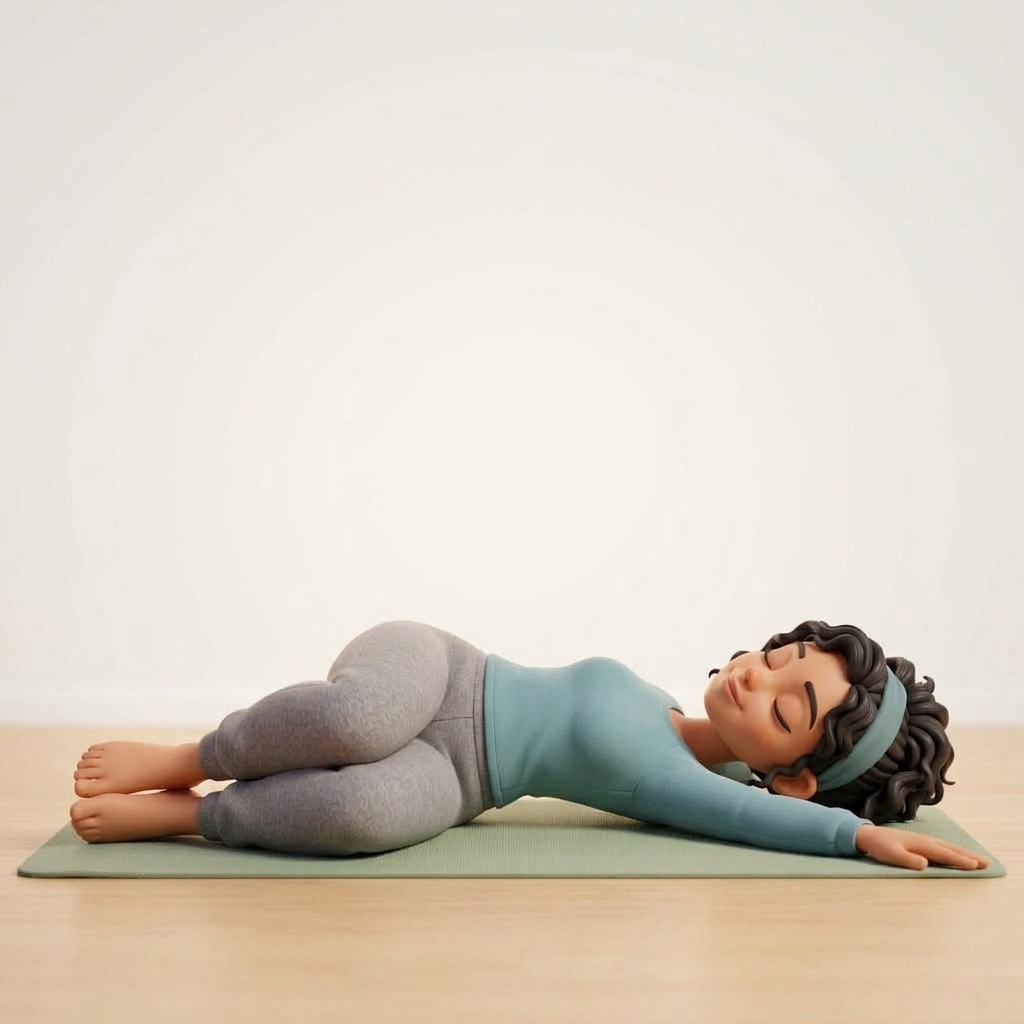
Execution Cue: Place feet mat-width apart and gently drop both knees to one side.
Lie on your back with knees bent and feet wide to the mat edges. Slowly drop both knees to the right, feeling a long, gentle stretch from your left lower back through your outer hip. Hold for 1 minute, then switch sides.
3. Low Crescent Lunge with Pelvic Tuck (Psoas Isolation)
Primary Function: Lengthens shortened hip flexors that pull on the lumbar vertebrae

Execution Cue: Tuck tailbone down and shift forward just 2 inches to target the deep hip flexor.
Step right foot forward into a 90-degree lunge with back knee resting on a folded blanket. Tuck your tailbone downward to flatten your lower back, then gently ease forward 2 inches. Hold for 30 seconds per leg.
4. Wide-Knee Supported Child's Pose
Primary Function: Opens inner adductors while decompressing the lumbar vertebrae
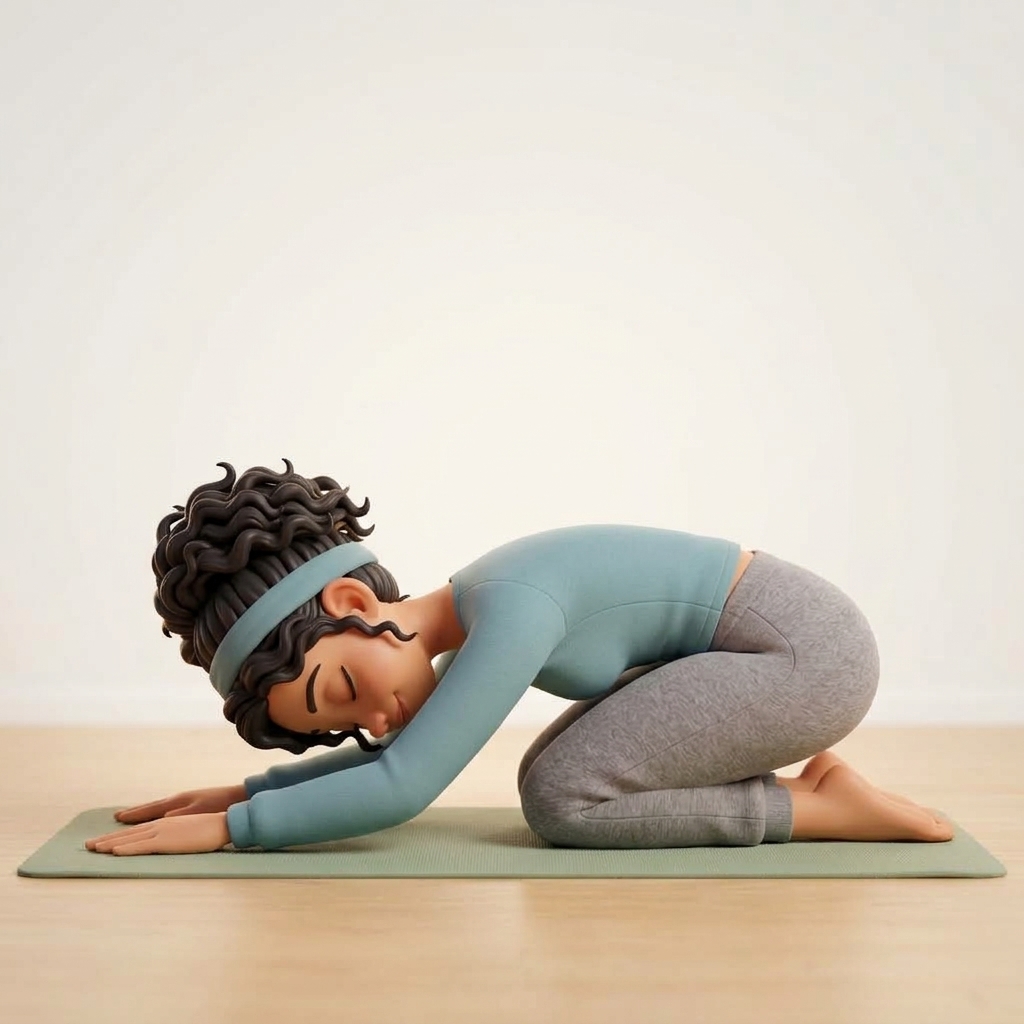
Execution Cue: Spread knees wide to give your lower back space to expand effortlessly.
From tabletop, open knees wide to the edges of your mat, touch big toes together, and sink hips onto heels. Walk hands forward and rest forehead on the mat. Breathe into your lower back for 2 minutes.
5. Restorative Legs-Up-The-Wall Decompression
Primary Function: Completely eliminates gravitational load on both the hips and lumbar spine

Execution Cue: Elevate legs up the wall with a folded blanket under your sacrum for elevated comfort.
Swing your legs up against a wall while resting your back and head on the floor. Allow the femur heads to sink deeply into the hip sockets under gravity. Rest for 5 peaceful minutes.
Daily mobility cannot fully overcome 8 hours of sitting at an uncalibrated desk or poor screen height.
→ Optimize Your Station: Use our Interactive Desk Calculator or test your alignment on our 60-Second Posture Test.
Frequently Asked Questions
Why do my hips and lower back hurt on the same side?
A unilateral back and hip ache is almost always driven by a hypertonic Quadratus Lumborum (QL) and tight gluteus medius on that side, which pulls that hip bone upward and pinches the L4-L5 facet joints.
Can tight hips cause sciatica symptoms?
Yes. The piriformis muscle is a deep hip external rotator. When tight hips restrict normal gait, the piriformis spasms and compresses the sciatic nerve (pseudo-sciatica).
How long does it take to loosen tight hips and lower back?
With consistent daily practice of these 5 gentle restorative poses, noticeable relief from morning stiffness occurs within 7 to 10 days.