 Tar Pit Yoga
Bedtime Yoga for Sleep & Back Pain: 5 Restorative Evening Poses
If your lower back throbs the moment you lie down, daytime spinal compression and unconscious nervous system guarding are preventing your body from entering deep restorative sleep. Here is a 10-minute bedtime routine you can perform directly in bed.

Core Sleep Rule: Zero effort, 100% surrender. Use pillows to support every limb so the brain drops its protective muscle-guarding reflex.
The Medical Puzzle: Why Back Pain Flares Up When You Lie Down
Many people find that their back pain feels tolerable while standing or moving during the day, but becomes agonizing the moment their head hits the pillow.
The Biomechanical Explanation (Osmotic Rehydration): Throughout a day of walking and sitting, gravity exerts continuous axial pressure on your spine, causing intervertebral discs to lose fluid and compress. When you lie horizontally at night, the compressive load drops to near zero. Your discs immediately begin absorbing fluid like dry sponges (osmotic rehydration), expanding by up to 20% in volume.
If your surrounding paraspinal muscles and hip flexors are locked in spasm, this rapid disc swelling creates intense mechanical pressure against sensitive nerve endings.
Muscles cannot relax if your sympathetic nervous system is still processing work emails and daily stress. As documented in TMS mind-body research, emotional tension causes micro-vasoconstriction in lumbar tissues.
→ Try It Tonight: Sync this bedtime routine with our free Interactive 4-7-8 Breath Pacer. Prolonged exhalations trigger acetylcholine release, dropping heart rate within 2 minutes.
The 5-Step Restorative Bedtime Routine
(Perform these poses on your yoga mat or directly on top of your bed mattress before sleeping).
1. Reclining Knee-to-Chest (Supta Apanasana)
Primary Function: Flattens the lumbar lordosis and opens compressed L4-L5 and L5-S1 facet joints • Hold Time: 10 deep breaths per leg

Execution Cue: Keep your head flat on your bed pillow. Gently draw your knee toward your armpit, feeling the lower back melt flat.
- Lie supine on your mattress. Extend your left leg long and relaxed.
- Bend your right knee and interlace your fingers around your shin.
- Gently draw the right knee toward your chest and slightly outward toward your right armpit.
- Take 10 slow, rhythmic diaphragmatic breaths, feeling your lower abdomen rise against your thigh. Switch legs smoothly.
2. Restorative Bedtime Spinal Twist (Supta Matsyendrasana)
Primary Function: Unlocks rotary spinal tension and releases the quadratus lumborum (QL) • Hold Time: 2 minutes per side
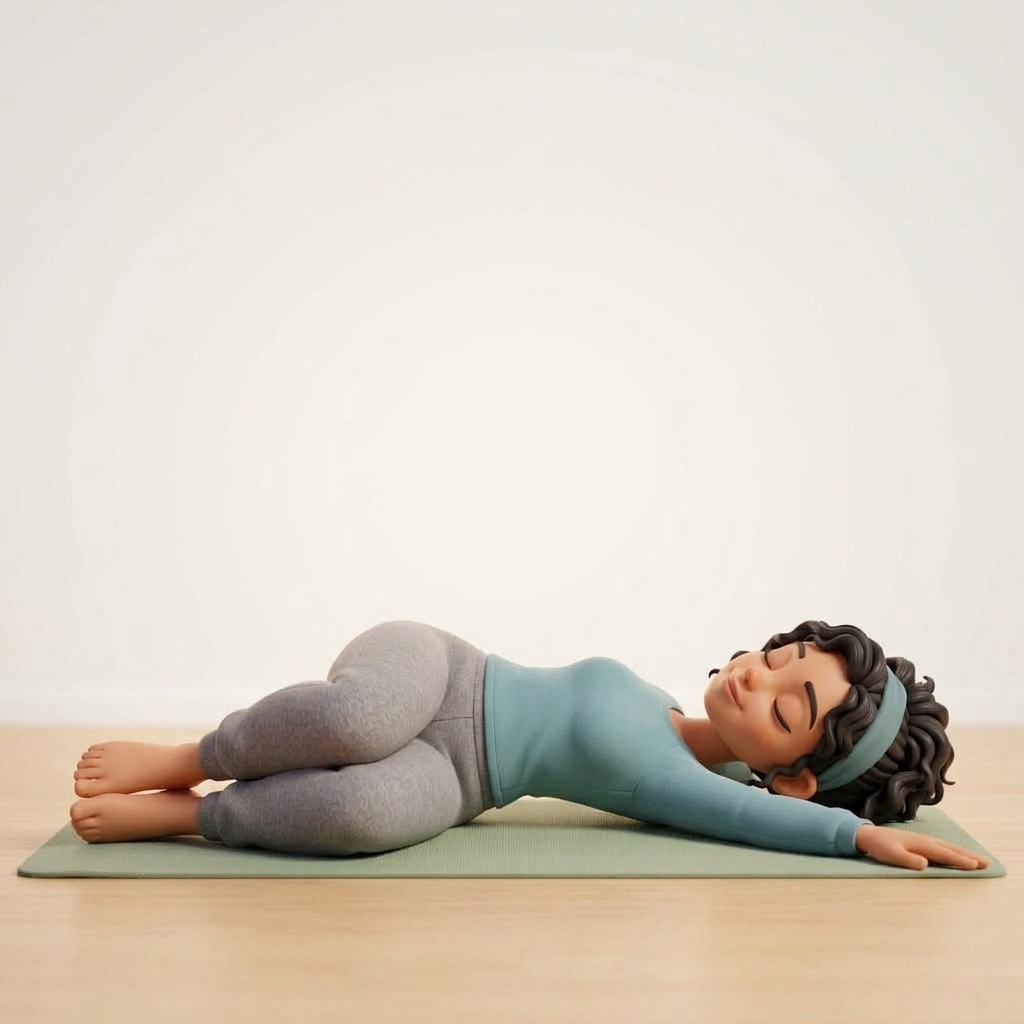
Execution Cue: Place a bed pillow between your knees so your upper hip remains level and unsupported tension is eliminated.
- Lie on your back with arms relaxed in a comfortable T-shape.
- Bend both knees with feet flat, lift your hips, and shift them 1 inch to the right.
- Drop both knees softly to the left onto your mattress. Place a bed pillow beneath or between your knees.
- Turn your gaze gently to the right if comfortable for your neck. Close your eyes and exhale fully for 2 restful minutes per side.
3. Supported Child's Pose with Pillow Hug (Balasana)
Primary Function: Deep proprioceptive nervous system calming & spinal erector lengthening • Hold Time: 3 minutes
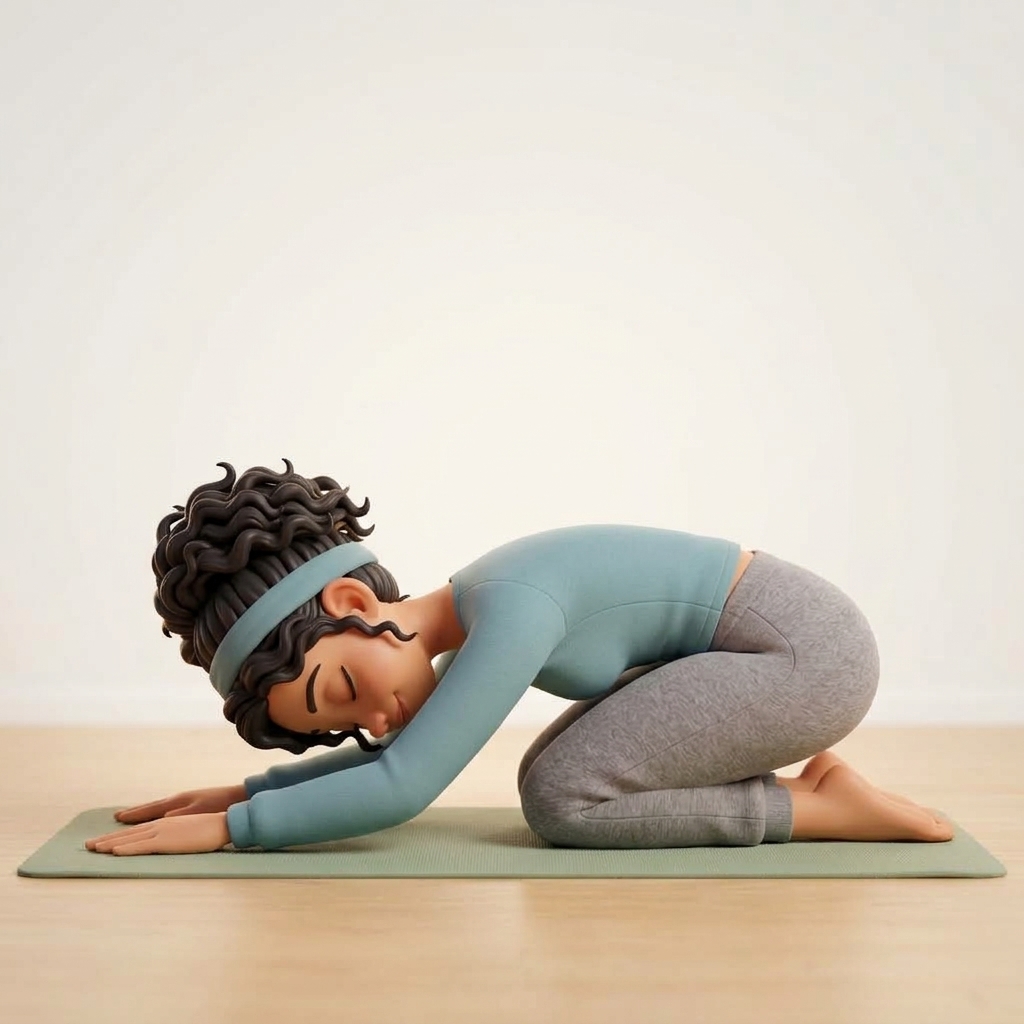
Execution Cue: Place a thick bed pillow lengthwise between your thighs. Hug the pillow with your arms and turn your cheek to the side.
- Kneel on your mattress with knees wide and big toes touching.
- Place a thick sleeping pillow or bolster lengthwise between your knees.
- Fold your torso forward onto the pillow, resting your chest and abdomen completely on its surface.
- Wrap your arms gently around the pillow. Breathe slowly into the back of your ribcage, feeling the spinal vertebrae separate on every inhale.
4. Supported Bridge Pose on a Pillow (Setu Bandha Sarvangasana)
Primary Function: Passively opens tight hip flexors (psoas) without lower back strain • Hold Time: 2 minutes

Execution Cue: Slide a folded firm pillow directly beneath your sacrum (tailbone), not your lower back.
- Lie on your back with knees bent and feet flat on the bed, hip-width apart.
- Press into your heels to lift your pelvis just high enough to slide a firm pillow under your sacrum.
- Lower your hips onto the pillow. Let the pillow take 100% of your pelvis's weight.
- Rest your arms outward with palms facing up. Feel the gentle, passive opening across the front of your hips and lower belly.
5. Legs-Up-The-Wall / Headboard Restorative Inversion (Viparita Karani)
Primary Function: Reverses venous gravity, drains tired legs, and triggers rapid melatonin release • Hold Time: 5 minutes
Execution Cue: Scoot your hips close to your headboard or wall and rest your legs vertically upward. Keep a micro-bend in your knees.
- Sit sideways near your headboard or wall on your bed. Swing your legs up against the wall while lowering your shoulders and head onto the mattress.
- Place a small pillow under your head and another beneath your hips for optimal comfort.
- Rest your arms in a relaxed cactus shape or gently across your lower abdomen.
- Close your eyes and breathe slowly for 5 minutes. Feel the heaviness drain from your legs and a deep, tranquil calm settle over your nervous system. Slide down under the covers when finished.
If you sit all day at an uncalibrated desk, your hip flexors and neck muscles spend 8 hours in sustained shortening, causing rebound spasms in bed.
→ Fix the Root Cause: Check your chair setting on our Desk & Chair Height Calculator, or test for posture imbalances on our 60-Second Posture Test.
Frequently Asked Questions About Bedtime Yoga
What is the best sleeping position for lower back pain?
If sleeping on your back, place a firm pillow beneath your knees to flatten the lumbar lordosis. If sleeping on your side, place a thick pillow between your knees and ankles to prevent your top hip from rotating forward and twisting the sacroiliac (SI) joint.
Will doing yoga before bed give me too much energy?
Active Vinyasa yoga can elevate body temperature and heart rate, but restorative yoga uses slow, grounded postures and prolonged exhalations specifically designed to activate the parasympathetic "rest-and-digest" response, lowering core temperature and preparing you for sleep.
How long does it take for nighttime back pain to improve?
Most individuals experience noticeable relief from nocturnal back throbbing within 3 to 5 nights of practicing this restorative routine and 4-7-8 breathing before turning off the lights.
← Restorative Yoga for Tight Hips Practice 4-7-8 Sleep Breath Pacer →