 Tar Pit Yoga
How to Fix Anterior Pelvic Tilt: 5 Daily Stretches & Corrective Exercises
If you spend hours sitting at a computer, you likely have Anterior Pelvic Tilt (APT): the pelvis tilts forward, the lower back arches excessively (hyperlordosis), and the lower belly protrudes. Here is how gentle restorative movement resets pelvic alignment and eliminates lumbar ache.

Core Correction Rule: Reconnect the glutes, lengthen the hip flexors, and pull the pelvis back into level neutral.
The Biomechanics: Understanding "Lower Crossed Syndrome"
Anterior Pelvic Tilt is not a bone deformity; it is a muscular imbalance described in physical medicine as Lower Crossed Syndrome (first classified by Dr. Vladimir Janda):
- Chronically Tight & Shortened: Iliopsoas (deep hip flexors), rectus femoris (quads), and lumbar erectors (lower back muscles).
- Chronically Weak & Inhibited: Gluteus maximus (buttocks), hamstrings, and the deep transverse abdominis (core stabilizers).
When your hip flexors tighten from 8 hours of desk work, they act like tight guide-wires, physically yanking the front rim of your pelvis downward. Your lower back muscles contract to keep you upright, pinching the facet joints of your lumbar spine (L4-S1).
Sit on the very edge of a firm bed or table. Hug one knee firmly against your chest and roll backward onto your back. Let your other leg hang off the edge.
• Normal Alignment: The hanging thigh drops parallel to the floor or slightly below with a 90° bend at the knee.
• Anterior Pelvic Tilt: The hanging thigh stays lifted above horizontal, or the knee kicks outward. This confirms shortened hip flexors pulling on your pelvis!
The 5-Step Daily Corrective Routine
1. Dynamic Cat-Cow Pelvic Tilts (Chakravakasana)
Primary Function: Mobilizes the lumbosacral junction and restores conscious control of posterior pelvic tucking.
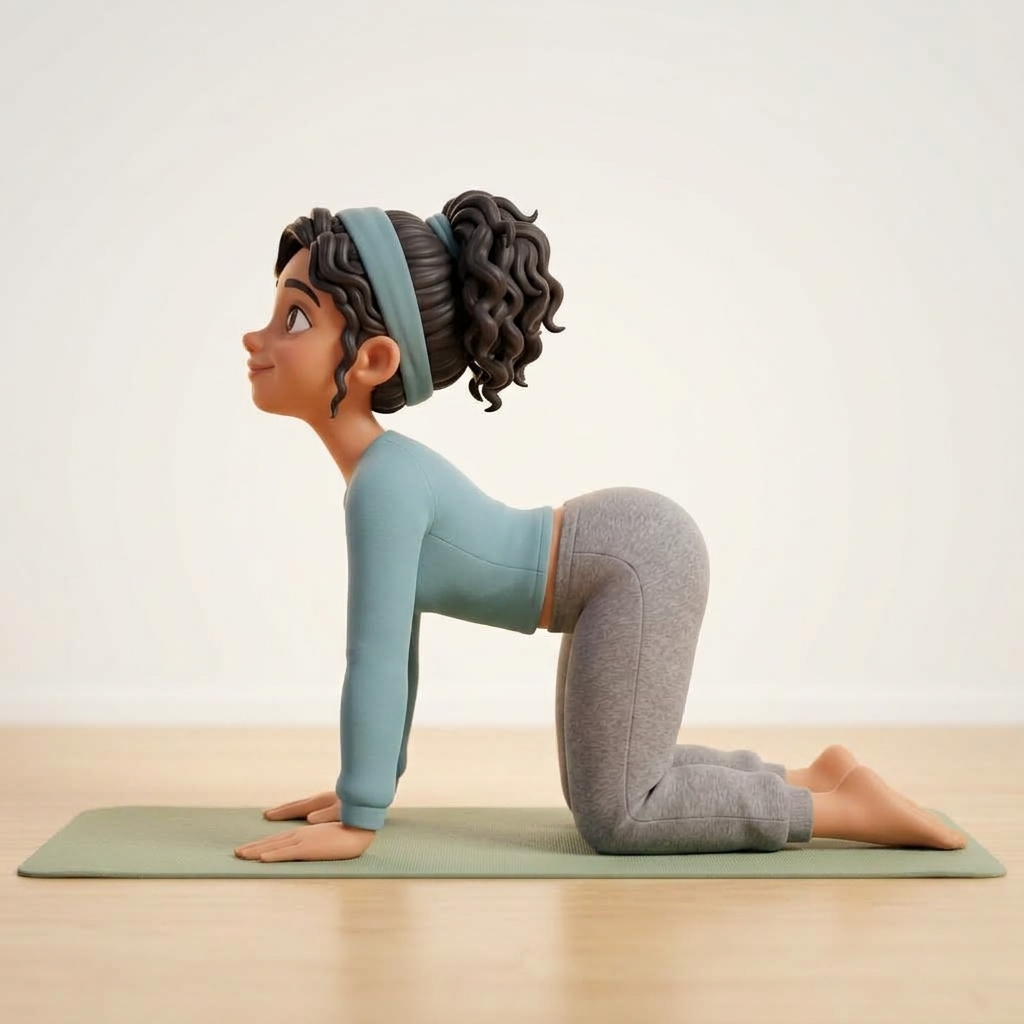
Execution Cue: Emphasize the "Cat" phase. Actively pull your pubic bone toward your ribcage and breathe into your lower back.
- Begin on hands and knees with wrists under shoulders and knees directly under hips.
- On an exhale, initiate movement solely from the pelvis: tuck your tailbone downward, scoop your belly inward, and round the entire spine toward the ceiling (Cat Pose).
- Pause for 3 seconds in full posterior tuck, feeling your abdominal wall engage.
- On an inhale, gently return to neutral. (Avoid aggressive sagging into Cow pose if lower back feels pinched). Repeat 10 slow breath cycles.
2. Glute Bridge with Posterior Pelvic Lock
Primary Function: Wakes up inhibited glutes ("glute amnesia") to pull the pelvis back into neutral alignment.
Execution Cue: Do not arch through your lower back. Flatten your ribs and squeeze your glutes at the top.
- Lie on your back with knees bent, feet hip-width apart and flat on the floor, fingertips brushing your heels.
- Before lifting, tilt your pelvis backward so your entire lower back presses flat into the mat with zero gap.
- Maintaining that pelvic tuck, drive through your heels to lift your hips until knees, hips, and shoulders form a straight line.
- Hold at the peak for 5 seconds, consciously clenching the glutes. Lower with control. Perform 3 sets of 8 repetitions.
3. Reclining Knee-to-Chest Lumbar Reset (Apanasana)
Primary Function: Decompresses compressed posterior facet joints and releases tight lumbar paraspinal muscles.

Execution Cue: Keep your head relaxed. Draw the knee gently toward the chest until the lower spine softens flat.
- Lie supine. Extend your left leg straight along the floor.
- Hug your right knee in toward your chest, clasping your hands around the right shin.
- Allow your sacrum and lower back to spread wide across the floor, reversing hyperlordosis.
- Hold for 8 to 10 slow, deep diaphragmatic breaths, then switch to the opposite side.
4. Wide-Knee Supported Child's Pose (Balasana)
Primary Function: Eliminates axial compressive gravity on the L5-S1 disc junction.
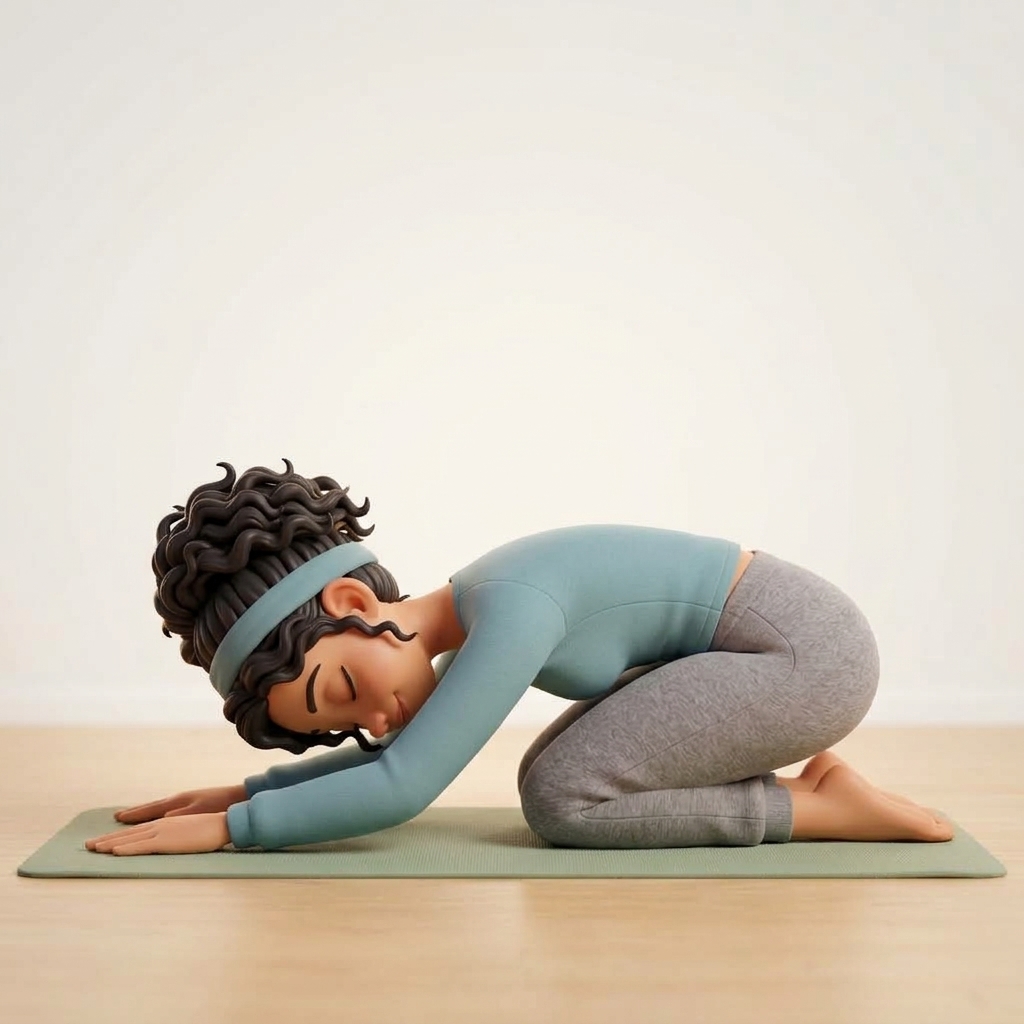
Execution Cue: Open knees wider than ribs so your lower spine can gently round without abdominal restriction.
- From tabletop, touch your big toes together and spread your knees wide to the mat edges.
- Send your hips back to your heels and walk your hands forward, resting your forehead on the mat.
- Breathe deeply into the back of your waist, feeling the lower lumbar vertebrae separate on each inhale. Hold for 2 minutes.
5. Legs-Up-The-Wall Sacral Decompression (Viparita Karani)
Primary Function: Lengthens tight hamstrings passively and reverses the gravitational pull of prolonged sitting.

Execution Cue: Place a folded towel or thin pillow beneath your sacrum for elevated comfort.
- Sit sideways against an open wall, gently pivot your hips, and extend your legs vertically up the wall.
- Rest your arms outward in a relaxed "cactus" or 45-degree angle.
- Close your eyes and breathe slowly for 3 to 5 minutes, allowing gravity to draw the femur heads into the hip sockets.
If your office chair seat pan is angled incorrectly or your desk is too tall, you are forced to sit on your pubic bone with an over-arched lumbar spine all day.
→ Fix Your Setup: Use our free Interactive Ergonomic Desk & Chair Height Calculator to find your exact seated elbow height and popliteal chair setting.
Frequently Asked Questions About Anterior Pelvic Tilt
Can anterior pelvic tilt cause sciatica and leg tingling?
Yes. Forward pelvic rotation pinches the lumbosacral nerve roots at L4-S1 and causes the piriformis muscle to over-contract in compensatory stabilization, leading directly to pseudo-sciatica. See our clinical Yoga for Sciatica Guide for nerve flossing protocols.
Should I sleep with a pillow under my knees?
Yes. When sleeping on your back, placing a firm pillow beneath your knees slightly flexes the hips, allowing the lumbar spine to rest flat against the mattress instead of hyperextending overnight.
Are squats and deadlifts safe with anterior pelvic tilt?
Only if you maintain a neutral spine. Many people with APT over-arch during the lockout of squats and deadlifts, jamming the lumbar vertebrae together. Master the posterior pelvic tuck with bodyweight bridges first before loading heavy barbells.
← 5 Restorative Poses for Back Pain Check Your Desk Height Specs →