 Tar Pit Yoga
How to Fix Tech Neck: 5 Stretches for Forward Head Posture & Dowager's Hump
Tilting your head forward at a laptop or phone multiplies the gravitational weight of your skull from 12 lbs to an astonishing 60 lbs. Here is how gentle somatic movement and deep flexor activation reverses Upper Crossed Syndrome and eliminates chronic neck spasms.

Neutral Ear-Over-Shoulder Rule: Your ear canal should align directly above the center of your shoulder joint, keeping cervical disc compression at zero.
The Physics of "Text Neck": The 60-Pound Head
In a landmark biomechanical study published in Surgical Technology International, spine surgeon Dr. Kenneth Hansraj modeled the mechanical forces exerted on the human cervical spine at various angles of flexion:
- 0° (Neutral Posture): 10 to 12 pounds (4.5 – 5.5 kg) — Normal baseline.
- 15° (Slight Forward Gaze): 27 pounds (12.2 kg) — Double the baseline load!
- 30° (Laptop / Low Monitor): 40 pounds (18.1 kg) — Extreme muscular strain.
- 45° (Tablet Reading): 49 pounds (22.2 kg) — Chronic disc flattening.
- 60° (Smartphone in Lap): 60 pounds (27.2 kg)! — Equivalent to carrying a 7-gallon water jug on your neck!
When your head remains jutted forward for hours, the body compensates by forming dense fibrous tissue and fat at the base of the neck (the C7-T1 cervicothoracic junction). This protective bumper is what people commonly call a "Dowager's Hump" or "Buffalo Hump."
Understanding Upper Crossed Syndrome
Just as prolonged sitting creates Anterior Pelvic Tilt in the lower body, prolonged desk posture creates Upper Crossed Syndrome in the neck and shoulders (first documented by Dr. Vladimir Janda):
- Chronically Tight & Hyperactive: Upper trapezius, levator scapulae (neck string muscles), suboccipitals, and pectoralis minor.
- Chronically Weak & Inhibited: Deep cervical neck flexors (longus colli and longus capitis), rhomboids, and lower trapezius.
Because your suboccipital muscles are permanently clenched to prevent your head from falling into your lap, they compress the greater occipital nerve, causing tension headaches that radiate behind the eyes.
The 5-Step Restorative Routine to Reverse Tech Neck
1. The Deep Cervical Chin Retraction (The Chin Tuck)
Primary Function: Wakes up dormant longus colli muscles and shifts C1-C7 back into stacked alignment.
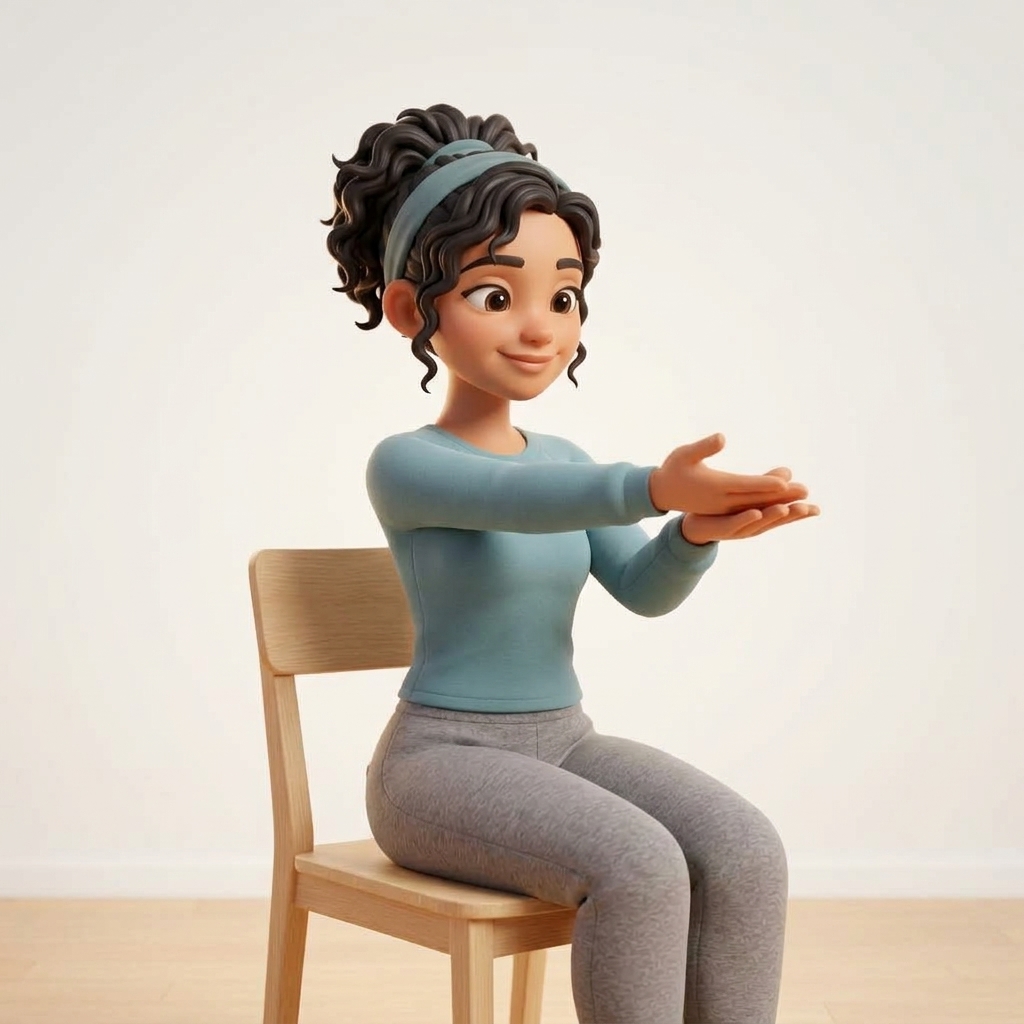
Execution Cue: Do not tilt your head down. Slide your chin straight back as if making a subtle double chin.
- Sit upright with shoulders relaxed and back against your chair. Look straight ahead at eye level.
- Place two fingertips on your chin. Without tilting your head down, gently glide your chin straight backward toward your spine.
- Hold the retracted position for 5 seconds. You should feel a deep stretch at the base of your skull and activation in the front of your throat.
- Release smoothly forward to neutral. Perform 10 controlled repetitions twice daily.
2. Doorway Pectoral & Thoracic Outlet Expansion
Primary Function: Opens rolled-forward shoulders and releases tight pec minor muscles that pinch blood flow to arms.
Execution Cue: Keep ribs tucked and avoid arching the lower back while stepping through the doorway.
- Stand inside an open doorway. Place your forearms flat against the doorframe with elbows bent at 90 degrees.
- Step one foot forward and gently shift your bodyweight through the frame until you feel a comfortable stretch across your anterior chest and shoulders.
- Draw your shoulder blades down and back. Take 5 deep belly breaths, allowing the chest to expand horizontally.
- Step back and repeat with arms angled slightly higher (120 degrees) to target different pectoral fibers.
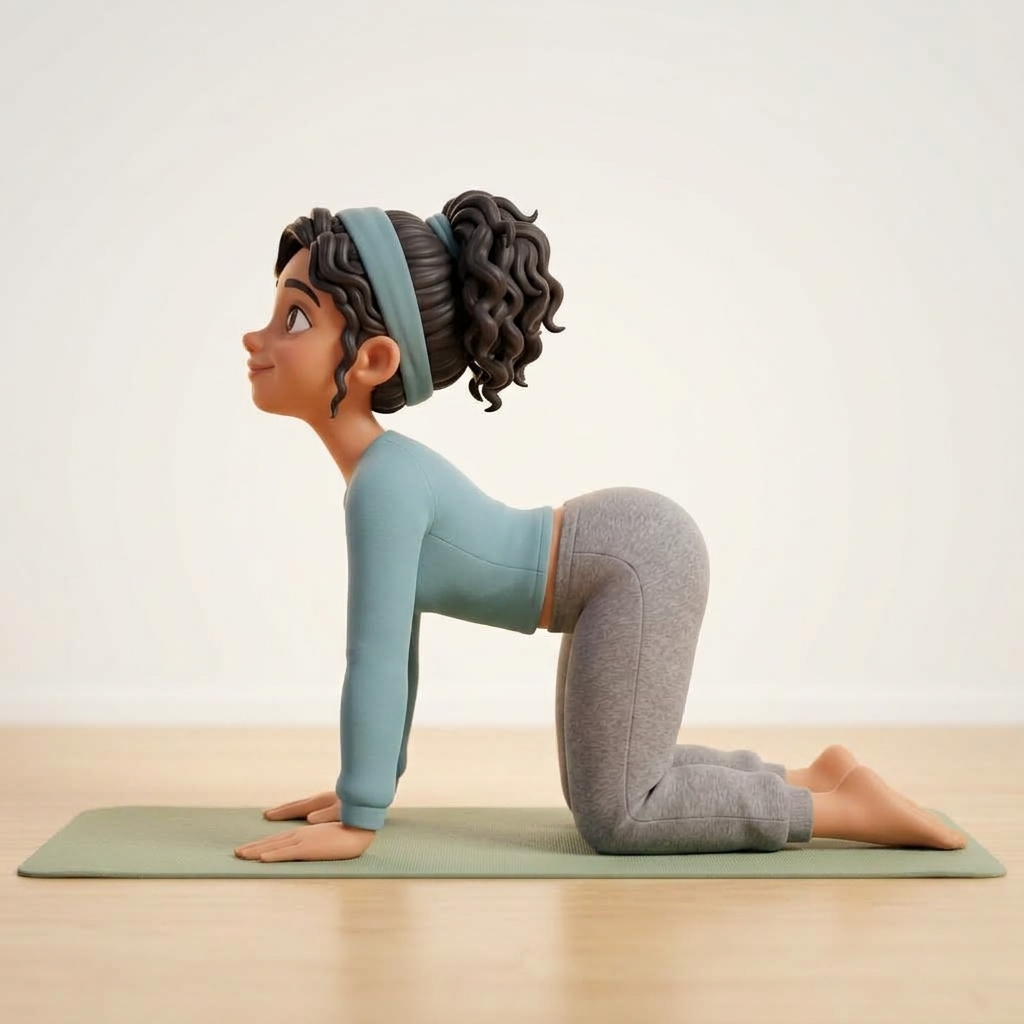
3. Dynamic Cat-Cow Thoracic Wave (Chakravakasana)
Primary Function: Mobilizes the stiff middle back (T1-T12) so the neck does not have to overcompensate.
Execution Cue: Focus movement between your shoulder blades rather than excessive lower back arching.
- Begin on hands and knees with wrists under shoulders and knees under hips.
- On an inhale, lift your chest forward through your arms, drawing shoulder blades together (Cow Pose). Keep the back of your neck long; do not crank your head backward.
- On an exhale, press the floor away, rounding your upper thoracic spine toward the ceiling while tucking the chin softly to chest (Cat Pose).
- Repeat for 10 slow, fluid breath cycles, synchronizing movement with breath.
4. Supported Child's Pose with Arm Decompression (Balasana)
Primary Function: Removes all compressive axial gravity from the cervical and thoracic vertebrae.
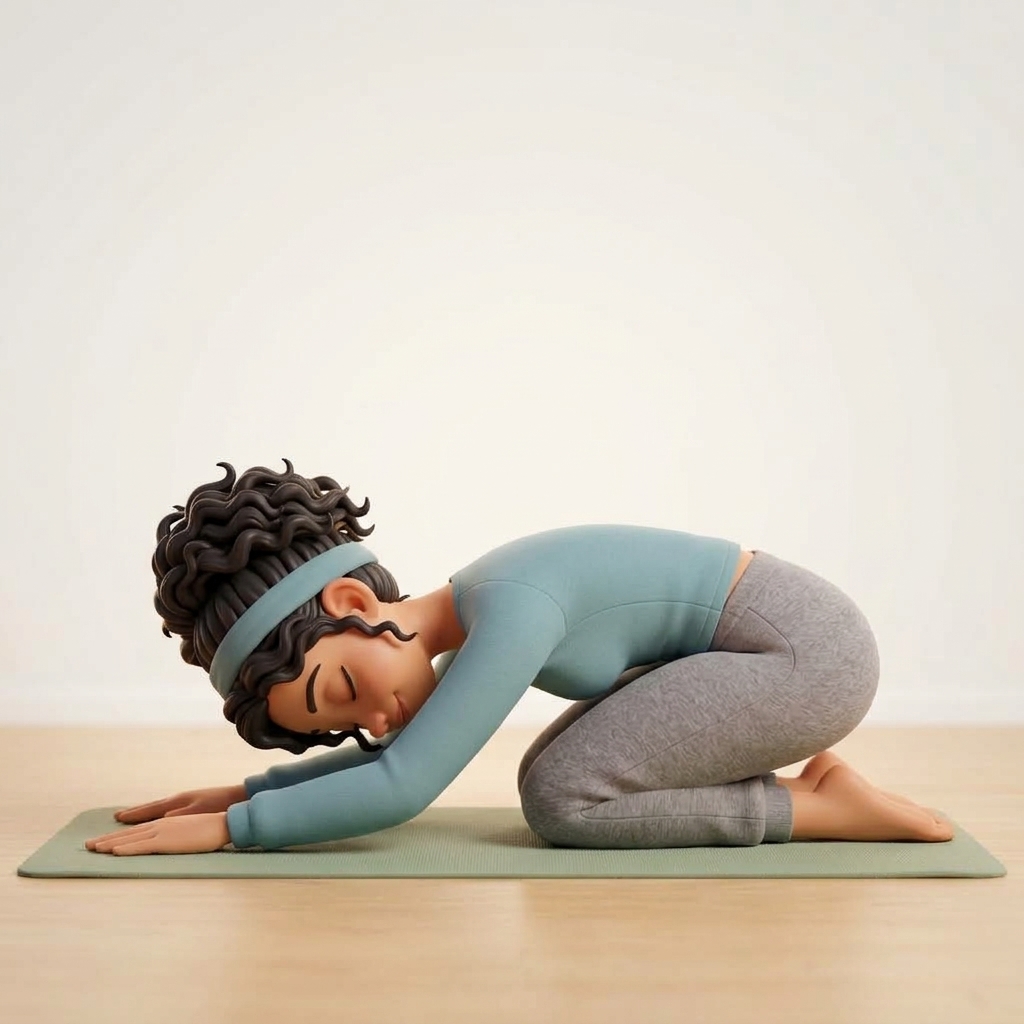
Execution Cue: Rest your forehead on a yoga block or the mat to let the posterior neck muscles fully release their holding pattern.
- From tabletop, open your knees wide to the mat edges and bring big toes together.
- Sink your hips back to your heels and stretch your arms out long in front of you.
- Rest your forehead gently on the mat. Let the weight of your head be 100% supported by the floor.
- Breathe deeply into the space between your shoulder blades for 2 to 3 minutes, feeling chronic tension melt away.
5. The Desk Median Nerve Glide & Shoulder Reset
Primary Function: Releases compressed brachial plexus nerves radiating from the neck down into the forearms and wrists.
Execution Cue: Floss the nerve gently. If you feel electric tingling in your fingertips, reduce the stretch by 20%.
- Sit tall with shoulders relaxed. Extend your right arm straight out to the side with palm facing up.
- Flex your wrist backward so your fingers point downward toward the floor.
- Gently tilt your head to the left shoulder (away from the outstretched arm). You will feel a gentle neural stretch running from neck to palm.
- Hold for 3 seconds, ease off by returning your head to center, and repeat 5 times per side. (See our full RSI Ergonomics Protocol).
You cannot exercise your way out of a screen that is 4 inches too low. Every inch your monitor sits below eye level forces an extra 10 degrees of head flexion.
→ Calculate Your Exact Setup: Use our free Interactive Ergonomic Desk & Monitor Height Calculator to find your optimal screen eye-line and chair height.
Frequently Asked Questions About Tech Neck
Can tech neck cause tingling or numbness in the fingers?
Yes. Forward head posture and tight pectoralis minor muscles compress the brachial plexus (the bundle of nerves traveling from the cervical spine down into the arm), a condition known as thoracic outlet syndrome. This is frequently misdiagnosed as carpal tunnel syndrome.
How long does it take to fix forward head posture?
With daily chin tucks, pectoral stretching, and elevating your workstation screen, acute neck aching typically subsides within 10 to 14 days. Measurable structural improvement in cervical posture takes 6 to 10 weeks of consistent retraining.
Should I crack or pop my neck for relief?
No. Habitual neck cracking stretches the cervical ligaments, leading to ligament laxity and hypermobility in already loose segments while leaving stiff segments locked. Replace cracking with gentle chin tucks and diaphragmatic breathing on our Breath Pacer.
← Take the 60-Second Posture Test Calibrate Your Monitor Height →